

Masked by months of steady upward trends in the health care and social assistance sector, the underlying condition of the U.S. economic jobs market was stripped bare following February’s jobs numbers.
Health care serves as a critical, strategic pillar and cornerstone to southern Oregon’s economy. Chances are, if you found yourself in a room filled with 100 community members and there was a medical emergency, roughly 20 of the people around you would work in the profession equipped to respond.
One in five people in the Rogue Valley are employed in the health care and social assistance sector, representing more than 19,000 jobs, according to statistics from the Oregon Employment Department (OED).
For months, health care has propped up the U.S. jobs market, which would have effectively lost 78,000 jobs in 2025, if it had not been for increases in health care and social assistance.
Here at home, where the latest unemployment numbers climbed to 5.2% in December, these services are a vital piece of our southern Oregon economy. At the broad industry level, health care and social assistance are the largest employment sectors in Jackson County. OED further shows that health care occupations in the Rogue Valley pay higher than the U.S. mean average wage.
Across the country, health care is providing life support for an economy under strain. This key pillar has supported under significant economic pressure, but without it, a point of vulnerability is exposed.
This February, the U.S. unemployment rate rose to 4.4%, employers eliminated 92,000 positions and for the first time in months, the health care/social assistance sector lost jobs, some 19,000. Economists point to the nurses strikes in California and Hawaii involving 31,000 workers for the losses. Without the consistent and steady gains of one of the country’s most reliable supports, the fragility of the broader economy becomes more apparent.
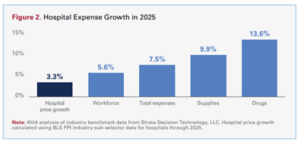
Even as this sector increasingly moves into a central role of the current economy, it still faces challenging regulatory demands. Hospital expenses grew more than twice the rate of hospital prices last year. Reimbursements remain lower than the cost of services. People are getting sicker and struggling with chronic illness.
These pressures become even more consequential when considering the industry’s future role in job growth.
As population demographics continue to age, it is expected that health care will continue to remain a significant contributor for job seekers. In a report from the State of Oregon Employment Department, the health care and social assistance industry is expected to grow 13% by 2034. By comparison, all other industries are projected at a 6% growth rate over that time. While these remain projections, this increase represents the potential for 40,400 new jobs in the Beaver State, with a high demand for nurse practitioners, physician assistants, therapists, technicians and more.
With the health care sector supporting so much of the nation’s job growth, additional pressures or unnecessary barriers don’t just affect hospitals and clinics, they affect the overall economic outlook. Thoughtful support for these services will give this sector the environment it needs to heal patients, grow skilled workers and make our communities and economy healthy.