
Author

Earlier this month, the Common Sense Institute of Oregon, a non-partisan research organization focused on the protection and promotion of Oregon’s economy, released an in-depth look at migration trends impacting Oregon.
The report highlights much of what businesses and health care providers throughout the state have been feeling – Oregon is losing high earning households to other states following years of outward migration, with those households being replaced, if at all, by lower earning households. For a state that is heavily dependent on income tax to fund the state budget, this is a significant structural problem.
2024 marked the first time since 2021 that Oregon had more arrivals than departures.
Between the years of 2022-2023, which is the latest year highlighted in the report, Oregon lost a net of $476 million in adjusted gross income – despite around the same number of households arriving and departing during the period measured – with departing households earning roughly $7,300 more per return than arrivals.[1]
According to the report, Oregon gained households among movers under 35, but lost both households and income across every age group between 35-64. The report notes the following:
In all working-age groups, arriving households earn less on average than departing ones — a gap that peaks at over $27,000 in the 45–54 cohort, which accounts for the largest net income loss at $277 million.
Locally, Jackson County had a net population loss of -.84%, driven by a 12.4% decline in unincorporated Jackson County during the period measured (Medford, Eagle Point, Talent and Jacksonville all gained population with much of that resulting from redistribution into incorporated areas); Josephine County grew 1.38% during that same period.[2]
The report also notes that Oregon continues to have a low fertility rate, at 1.36 in 2024, which is “the fifth lowest among all states and well below the 2.1 replacement level, according to the CDC’s National Center for Health Statistics — deaths now consistently outnumber births, meaning migration is the only path to population growth for the foreseeable future.”[3]
As Oregon’s population ages, if it is unable to replace the high earning households that have left, it will likely face systemic problems funding basic programs.
How this impacts the health care system
Oregon’s population trends are impacting health care delivery throughout the state. The loss of high-earning jobs is a double hit – first, the state loses significant tax revenue that it uses to funds schools, roads and key social programs, such as Medicaid.
Second, higher earning families more often carry employer-sponsored health insurance than lower earning families and the loss of these households decreases the overall commercial insurance coverage across the state.
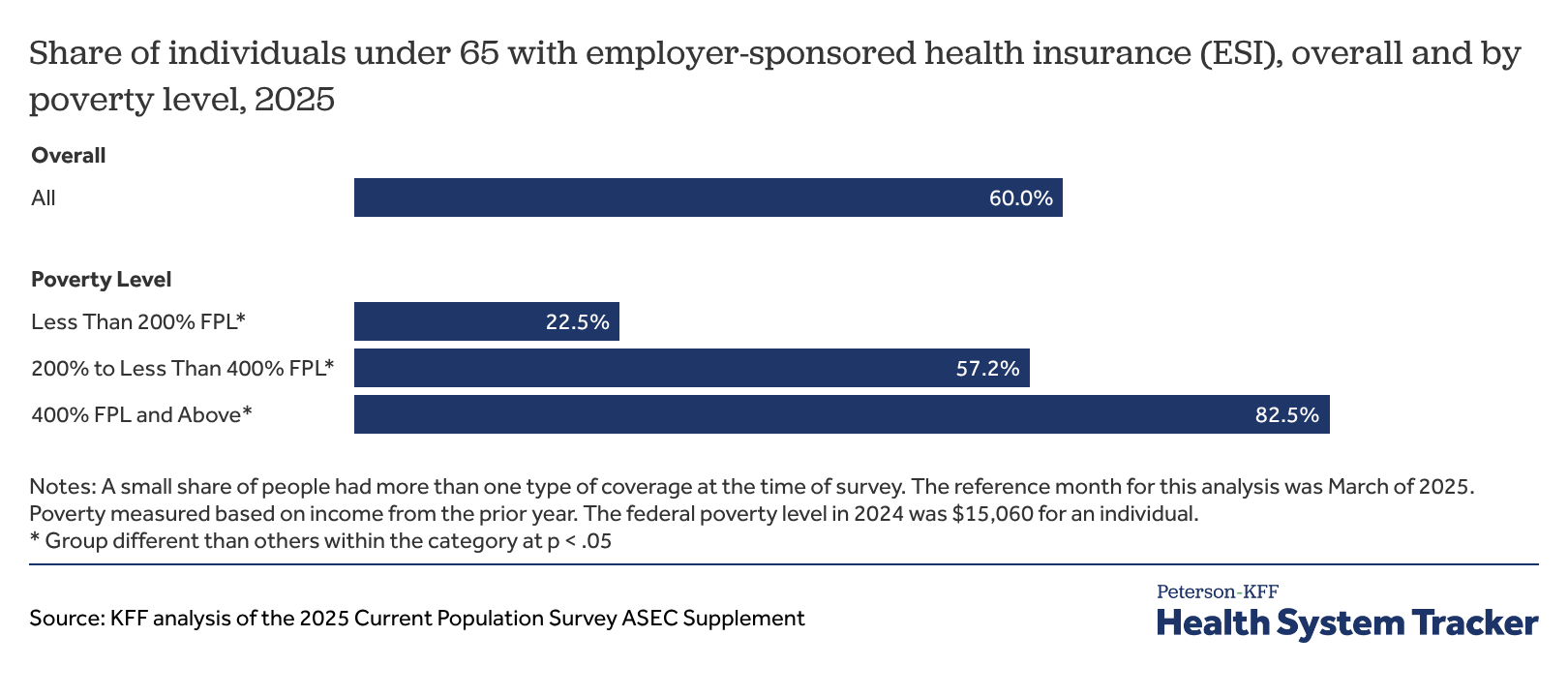 Source: Peterson-KFF Health System Tracker citing to KFF analysis of the 2025 Current Population Survey ASEC Supplement
As we’ve discussed before, Medicare and Medicaid do not cover the cost of providing care in Oregon, and health care systems and providers rely on commercial insurance to make up the gap. A loss of significant numbers of commercially insured households, coupled with a decrease in income tax needed to fund government programs, is a significant economic problem for health care providers and the Oregon economy as a whole.
The Common Sense Institute of Oregon report adds more data to a chorus of voices expressing concern over Oregon’s economic direction. Continued loss of high earning households and tax revenue risk further exacerbating Oregon’s economic problems and will place added stress on the health care delivery system, schools and universities, and local governments. We urge policymakers to take this issue seriously and to make bold changes to reverse these concerning trends.
[1] https://commonsenseinstituteus.org/research/migration-update-2024/
[2] https://commonsenseinstituteus.org/research/migration-update-2024/
[3] https://commonsenseinstituteus.org/research/migration-update-2024/